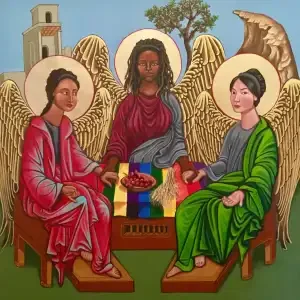
Trinity Sunday - ALL the Colours of the Rainbow
Trinity Sunday! Every curate’s nightmare, because allegedly, every vicar in the Church of England who had the benefit of a curate took it as an excuse to chicken out of preaching on this day and landed it on their poor colleague. Well I’m not blaming Fr David because the rota rules, and he is entitled to a Sunday in the pews, and Brother Dave, with an ordination coming up, deserves a free pass this year, so you are stuck with me, the last Dave standing.
Why should so many priests be reluctant to preach the gospel today in particular? It might be because most other celebrations in the Church’s year focus on a story, an event, or at least some particular teaching of Jesus. Trinity, in contrast, seems to be about abstract theology, or maybe even mathematics. God reduced to an algebraical equation. Or perhaps geometry.
George Edmund Street, the architect of this church, was very keen on geometry. All his buildings were designed with proportion and harmony in mind. You could sit here, if you were so inclined, and work out how he achieved that so beautifully. Or you could just let the details wash over you and be caught up in the beauty of the space.
In the same way, a preacher who was well trained in academic theology, or a mathematician, could no doubt give a perfect explanation of what the Trinity means in theory. But most of us aren’t theologians, and many of us used to dread maths lessons. So you’d probably be bored by a sermon like that and I wouldn’t make a good job of it either.
Fortunately there is another way of looking at it. One of the best sermons I’ve read (unfortunately not heard) is by my former spiritual director Fr Eric Simmons. For very many years he was a monk of the Community of the Resurrection in Mirfield, and reputed to be one of the best preachers in the Church of England. He died five years ago, but before that he preached what would have been one of his last sermons on Trinity Sunday.
Much of what I have got to say is inspired by that. Eric compares God to light. Ironic because he struggled with poor eyesight throughout his life, and it got progressively worse in his last few years. But light is real even when we can’t see it, and so is God. Maybe the less we can see and understand in this life, the more we search after its source.
When I was primary school age (a long time ago I know) I used to enjoy messing around with a paint box. We all learnt how to mix primary colours to make new ones: yellow and blue to make green, red and blue to make purple, and so on. We were taught that black and white aren’t colours. Black is the total absence of colours; white is the totality of colours.
So trying to prove that, I mixed together every colour I could find: blue, yellow, red, green, purple, brown and so on. But instead of producing white, the resulting mix was just a muddy sludge of greenish brown. Instead of snow, the bottom of the pond.
Then at secondary school we did an experiment with light. The teacher showed us a prism of glass, and shone a light through it. As you know, it became a rainbow. Every colour imaginable, and many besides. The experiment proved how light contained all colours, but it didn’t help you put them back together again to make light.
Light contains every colour imaginable, and many besides. The reason the experiment doesn’t work that way round is that we can only work with the colours that we can imagine. The problem is that we begin to think that the colours we can see, the truths we can grasp add up to the whole truth. As if the paints in our paintbox represent the whole spectrum of God’s infinite variety and love.
Most of us try our best. We plod through life, as the prophet Isaiah said, ‘here a little, there a little.’ We get a glimpse of wisdom here; an experience of love there; a peek at God’s mystery sometimes; a wink of humour; a glow of contentment; a hint of beauty. The world can be a terrifying place, but if you start to see it, God’s presence is everywhere. The eternal Light shines out through the prism of creation. ‘The world is charged with the glory of God’ says the poet Hopkins.
But these experiences usually come one at a time. ‘Here a little, there a little.’ And however much they make us aware of God’s glory, they don’t add up to a full picture. Put them all together and we maybe get confusion, or contradictions, a murky puddle of competing thoughts. We don’t get light.
So if we try to build up a picture of God by piling up our own insights or experiences, we’ll come to grief. Or worse, much worse, we believe that our insights and experience amount to the truth, and that other people, with other experiences, are wrong.
A symbol of the LGBT+ network is the rainbow. It’s adopted by many other people and groups such as Inclusive Church. It’s a sign that all people of many sexualities, gender identities, abilities, ethnicities and whatever distinctiveness, bring their own colour into the mix of human variety. Those original four letters have been extended into LGBTQIA, with a plus on the end to allow for yet more. It’s in danger of ending up like an alphabet soup, like the mix of paintbox colours turns to mud.
And there is a danger, if people identifying with one or more of those letters start rejecting those who identify differently. Or if they pretend that the rainbow we have put together equals the rainbow that is refracted from God’s light.
Our world is in great danger. Not from people of a different sexuality from ourselves. Not from members of other faiths. Not from those who speak a different language or have different coloured skin. The danger comes when those who have glimpsed a few of the colours of the rainbow start to act as if that is the whole truth, and refuse to accept that those who see differently are just seeing other aspects of the truth.
We use colour a lot in church. If you’ve spent time in this building you will appreciate the richness of the stained glass, the wall paintings and the statues. Most significantly, the colours that the priests wear to express the different seasons. Recently the white or gold of Easter gave way to the red fire of Pentecost; next week we go into green, the colour of nature, of growth, of Ordinary time. Solemn times of preparation like Advent and Lent we use purple.
The church’s year helps us to focus on different aspects of God, different glimpses of the truth. But however many of these we experience, it’s still like mixing colours out of a paintbox.
All those experiences are from God, and all help to form in us an awareness of God’s love. But once a year, as Fr Eric preached, ‘on Trinity Sunday, we are encouraged to screw up our eyes, so to speak, and try to look into that “deep but dazzling darkness” … which is GOD himself. …. Here we peer through the glass dimly to discern the One who is seated on the throne, the One who is the Source of all light, Uncreated and created, the Source of all Unity and Multiplicity.’
If we try to unpick it we will get hopelessly confused. We need to just sit back and bathe in God’s eternal Light, to stop worrying or debating or fighting each other, and relax in the simplicity of God’s love.